White Stakes Explained
March 4, 2026
DUNNELLON, FL — The Carl Spackler Open, a revered 54-hole amateur golf tournament with a rich history spanning two decades and crossing 14 states, has attracted 420 golfers over its existence. This esteemed four-day competition, known for its handicapped format, requires players to submit scorecards from their local games throughout the year.
Recently, the Captains Club, a group overseeing the event for 24 years, proposed changes aimed at streamlining future editions of the tournament. The proposal suggested simplifying proceedings by eliminating certain regulations, handicapping procedures, awards, designated tees, and the time-consuming scoring process.
Greg Long, Chairman of the Captains Club, emphasized the significant effort required from participants and volunteers to organize this individual golf competition. He advocated for a more relaxed approach without rules, handicaps, and competition. However, the proposal was ultimately rejected by the Captains Club, which unanimously voted to preserve the competitive nature of the Carl Spackler Open.
This decision underscores a commitment to maintain the essence of the tournament as a challenging handicapped golf event. As the event evolves, it aims to engage participants who relish the competitive spirit of golf.
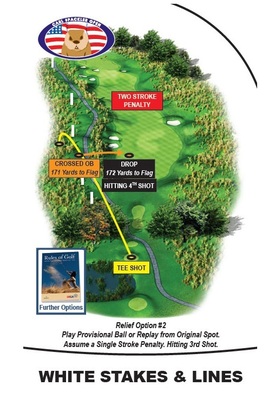
In a series of forthcoming articles, we will simplify the fundamental rules of golf. Today, we begin with the concept of "White Stakes," which are represented by white stakes or lines on the golf course. Similar to property lines marking boundaries at home, these stakes indicate the limits of the course.
Jason Ridgeway, an expert on golf rules, underscores the importance of white stakes, typically found near residential areas, roads, and other restricted zones. Crossing these boundaries results in a golf ball being declared "out of bounds," leading to a two-stroke penalty.
"We do not physically cross the white stakes to look for or claim a ball," said Jason Ridgeway. "The USGA asks you to move on without the ball."
Understanding this penalty is crucial. After determining where the ball crossed the boundary, players must estimate their distance to the flagstick and return to the nearest fairway edge without gaining an advantage. You drop while adding TWO penalty strokes.
"Everyone has two options when a tee shot goes out of bounds," said Ridgeway. "We hit another from the tee, which is our 3rd shot. Or we drop on the fairway edge from the same distance to flag as where the ball crossed the white stakes hitting our 4th shot. Its just that simple."
Looking ahead, the 2026 Carl Spackler Open promises fresh challenges at Juliette Falls Golf Club, featuring tree-lined fairways, expansive greens, and out-of-bounds areas. With 75 golfers expected to compete in this prestigious event, anticipation is high for another thrilling edition of amateur golf excellence.