Red (& Yellow) Stakes Explained
March 9, 2026
DUNNELLON, FL — The Carl Spackler Open has long prided itself on honoring both the spirit and the rules of the game. Now entering its third decade, the 54-hole amateur tournament has traveled across 14 states and welcomed more than 400 golfers, all competing in a four-day, handicapped format built on integrity and year-round score reporting.
Recently, the Captains Club — the group that has overseen the event for 24 years — debated whether to simplify the tournament by trimming certain regulations, handicapping procedures, awards categories, designated tees, and the labor-intensive scoring process.
Jason Ridgeway, member of the Captains Club, acknowledged the significant commitment required from both players and volunteers to sustain a competitive individual event.
“There’s no question this takes work,” Ridgeway said. “From collecting scorecards to administering handicaps to enforcing rules, it demands time and attention.”
While a streamlined, more relaxed format was discussed, the Captains Club ultimately voted unanimously to preserve the tournament’s competitive structure. The decision reaffirmed the event’s identity as a true handicapped competition — one that values both camaraderie and compliance with the Rules of Golf.
As part of an ongoing effort to clarify tournament standards, organizers have launched a series explaining six foundational golf rules in their simplest terms. This installment focuses on one of the most misunderstood areas in the game: penalty areas, commonly marked by red or yellow stakes.
Understanding Red and Yellow Stakes
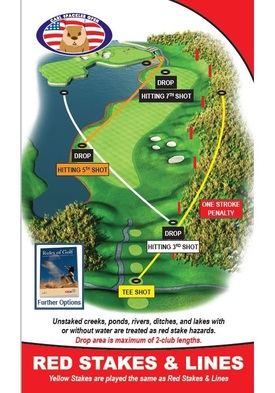
On most golf courses, colored stakes identify penalty areas. Historically, yellow stakes marked water hazards, while red stakes identified lateral hazards. Over time, however, courses began using red stakes for various non-water hazards to speed up play and simplify markings. The governing bodies eventually adopted the broader term “penalty area.”
At the Carl Spackler Open, both red and yellow stakes are treated the same to eliminate confusion and keep play moving.
“The distinction used to matter more,” explained Jason Ridgeway. “But today, it’s about identifying a penalty area and applying the proper one-stroke penalty.”
For many golfers, finding red stakes instead of losing a ball entirely can feel like a small victory. Unlike a lost ball — which requires stroke-and-distance relief — a ball entering a penalty area carries a single-stroke penalty and specific relief options.
The Proper Drop
When a ball enters a red- or yellow-staked penalty area, a player may take relief by dropping within two club lengths of where the ball last crossed the edge of the penalty area — no closer to the hole. Importantly, relief is based on the point of entry, not where the ball is found or where a player wishes it had crossed.
There is no automatic right to drop in the fairway.
“If your ball crossed near trees, rocks, or heavy rough, that’s where your relief area is,” Ridgeway noted. “You can’t move 30 feet into the fairway for a better angle. And you can’t claim the ball crossed the pond if it actually crossed the staked line short of it.”
Players may also choose to play the ball as it lies inside the penalty area — if it is safe and feasible to do so — but the one-stroke penalty still applies when relief is taken.
The Bottom Line
In practical terms, a tee shot that enters a penalty area results in adding one stroke and playing the next shot from the designated relief area. The consequence is significant but less severe than re-teeing under stroke-and-distance for a lost ball.
The rule reinforces a central theme of the Carl Spackler Open: accountability. Players are expected to know where their ball crossed the boundary, apply the correct relief, and protect the integrity of the competition.
The 2026 Carl Spackler Open will feature 75 golfers from 16 states competing over 54 holes, beginning with a practice round on Wednesday, April 15. With the tournament tees set at 6,450 yards — and 6,000 yards for seniors — the challenge will be real.
And so will the red stakes.